Showing posts with label Arabic. Show all posts

Saturday, April 9, 2011

End of week 2 report


I am finding it quite difficult to not be like the old Perez Hilton, who I read was going to stop being a cyber-bully. It seems so easy to be misconstrued or misrepresent myself, my real intention, particularly if members of my class are readers or heaven forbid the teacher or the faculty at ADAB(the local name for this part of the uni, not sure what it means). However, that likelihood is mitigated by the fact that some blog sites, this one included, are banned here. That + the fact that I get very few readers :O(

Anyhow, back to being Perez Hilton, it's been a really interesting time in class. Reflecting on what the teacher does and what I might do with the same people is super, and as a bonus I am sure my (posh, formal, RP)Arabic is coming on. However, I still have real beef with the course, and the teachers approach, a picky so-and-so I am, I know. I think one of the things I take umbrage with is the lack of classroom management.

She has good techniques, like mill drills but these are overused and the stages before and after them don't seem to make sense. The instructions when we do a mill are never sets them up beyond, “yalla, shabab – houna, ana, anti, anta, hua hia” meaning: “Come on everyone, here. I, you, he,she”. These mills are then cut short, and there is never enough time to (even if I wanted to, which I don't) go through all the verb conjugations. In order for this to be more to my taste I would perhaps like a goal or personalisation. I might like to be told who to work with, or how many people to work with, a time limit. We know each other quite well so it may be fairly easy to talk freely, and realistically, about each other. Furnishing us with question words and phrases like 'me too' would enable us to make more of these free practice opportunities. I often end up talking with a guy and practising “anti” (female you) which seems daft.. Encouraging (semi-)realistic, meaningful, language use would be another idea.

I am not the greatest of students but I think I work quite hard. I try to do my homework, I spend time thinking about and reflecting on classes, and try to manage my own motivation. However, when I am told by Z that I must learn it at home I am heartbroken. Why should I learn it at home, why don't you teach it to me properly!
That said I missed a few classes last week while attending the ISTEK conference in Istanbul. One of the more interesting things about this conference for English teachers, aside from leading an Intercultural Communicative Competence workshop, meeting ELT glitterati (and my Personal Learning Network) was that on the final day the thoughtful organisers included some beginner foreign language learning sessions (Spanish - Hebrew), which were I think sponsored by Berlitz (notorious drill 'em and kill 'em, factory-thinking-behaviourists). I was happy that this featured at their conference as it seems to validate this blog).

For many being a student of a foreign language has an indelible effect on how we (would) approach teaching ourselves. I don't teach in the same context as Mrs Pedel-Samways but if I did I wonder would I do things so differently? Thinking about the Turkish teachers I wonder how many of the participants in these language learning sessions thought back to their own classrooms and how they introduce new language items. Do they use a context or a text or a list? Do they elicit from their participants and work with what they know? How many language items do they introduce? (In my Arabic class the other day the introduction to a new unit consisted of the teacher drilling and translating 30+ items. This wasn't the first time this approach had featured). How do they scaffold the learning? Do they use progressively more difficult stages to increase the difficulty? Do they have text / visual cues that are gradually cut back? (requiring the students to operate with more and more autonomy) Do they drill in a military fashion? Do they allow for personalisation? And so on...(crikey, quite a list there).

Equally important about making teachers become students again is that we can again appreciate the difficulty faced by our students in our classes. This empathy and understanding informs student centred teaching. It is only by asking that we can find out what our students interests are, and likewise what their needs and wants are. Approaching groups of students in this way is tricky as people in the same group may have competing needs, however, doing this (finding out about our students needs and wants) means that we can meaningfully support all our students in pursuit of their goals. In our class the N.Korean girl needs Arabic to support her in diplomacy and in formal contexts. The Texan needs it for more rootsy and social purposes. I need to be able to survive here, not sound posh.

I have been in the position to pick up some useful snippets from my classmates of local Syrian-Arabic, that I can use around town. The focus of our course is 95% grammar, accuracy and speed focused. Language is being taught as content rather than as medium for communication. To exemplify it's the empty vessel analogy where the teacher fills the students empty head with their knowledge of grammar and so on. That's not me with the empty head. I already have a full head. I would like to be enabled to use the language communicatively rather than trained, like a performing seal, to recall certain fixed grammatical phrases on command. This isn't learning in the deep sense. I think I need to employ the language for a social purpose to 'learn' the language. I shouldn't complain as I am able to recall regular grammatical prefixes and suffixes fairly effectively and the Arabic tense system (as far as I can tell according to the beginners, pedagogical, grammar we are being taught) seems simple.

I am happy to receive suggestions about what aspect of my Arabic classes I should write about. What would interest you? More on cyber-bullying? OK, guess not. Il-e-leka...

Friday, March 18, 2011

A first class experience?


I had a sense of eager excitement and arrived about half an hour early. It felt important to get off on the right foot and show enthusiasm. Entering a new classroom is quite a daunting experience as a teacher and going in as a student was an occasion where affect was a factor. The room was already filling up by the time I arrived. The 'seatables' were arranged in a horseshoe so I walked in and took a free seat in the middle, right in front of the board. I was sat between S a Polish 22 year old with an American accent and Ali, who was as it turns out from Sheffield. Initially though we sat in silence waiting for our teacher to arrive and tell us what to do, strange that groups of students don't naturally introduce themselves. I thought about saying something but my morning head told me to shut up. It was the two Koreans (one from the North and one from the South) who were getting to know each other unprompted (amybe they knew each other already). In the room were, 2 Koreans, a German, a Czech, 2 Frenchies, 1 Italian, 1 Turk and Z our Syrian teacher.

The group is nice and range in age from 21 to 66. There was clearly a mix of knowledge already evident. Some of us were literate, others not so. Some knew how to count to 100, others (like me) not. For some the grammatical endings seemed familiar, for others it was new ground, and we covered a lot of it.

As a way of getting to know each other we covered the following ground: singular pronouns, 1st (ana min) 2nd (anta / anti) and 3rd person singular (hua / heeya); the word “isme”- my name is, your name is (male anamooka and female annamooki), his name is (annamukkhu), her name is (annamukkha). This was followed by “baduka”: I'm from; you're from (male and female); he's from; she's from. Then we did “medina”: my hometown is; your hometown is (male and female); his hometown is; her hometown is. We finished with saying our ages (omri), which the 66 year old was most displeased with! This was quite a lot for a four hour class conducted 95% in Arabic. I was a bit disappointed that there were no aims given at the start or a menu of the ground to be covered, I find it motivating to know what is coming up. That said, I felt at the end of the class like I had worked hard and I had a sense of completion and accomplishment at a few moments in the class.

There is the cognitive load of the real information, towns, countries, ages, then the added difficulty of saying these words in Arabic, though much was similar (Poland is Bolandia, for example). What struck me most about this was the amount of drilling. There was loads and loads of choral drilling and no variation to this. There was pair work and mills, more on that in a second, but there was a staggering amount of whole class repetition. This behaviourist trend worries me a bit. I hope that the aim behind this is to focus on pronunciation, not to scar these patterns of words onto our brains.

The mills were evident, and it was good to get out of the seat, but the instructions were a bit vague, talk to each other and no time limits were given meaning that often some of our loose, self-constructed groups, didn't get the chance to practice. I think these milling periods could have been extended a bit. I would like to have had a game or competitive slant to this. I would also like to have been organised a little more. Similarly, I sometimes have a certain shyness with regard to telling students what to do at the start of term. I soon loosen up :O). I was pleased there was a variety of interaction and despite a choral, pair, mill routine being established earlier on, there are worse routines in the world.

The teacher took a grammatical slant to this. We were focused on accuracy, both in form and pronunciation early and although everyone has lots to say, and interesting stories to tell, all the extraneous information must be kept at the door. This is perhaps the frustration of adult language beginners in any language, we come with heaps of knowledge and experience but can't verbalise it in the second language yet – dumbing us down. I am reminded of a nice activity I have used with Level one class before which is to give out a piece of paper and ask them to write all the words they know in English. This is usually met with disbelief, we are beginners, we don't have any words but in fact there are many English-loan words: computer and TV are just two of them found in many languages.

Anyhow, I rabbit away. The final part of the class, she introduced some letters, I was back on familiar turf and feeling cocky. Some in the class who may know how to speak, don't know how to read or write. This was pleasing, or more so a time to relax slightly and try to help my neighbours who were plunged in at the deep end.
Then at the end we did ages and numbers. There was no teaching for this and I didn't know how to say my age, or any number for that matter. This was a bit bad for me. I felt like a dummy and realised that those around me have considerable experience of using Arabic already as they unprompted spat out their ages and those around them.

We're off.

Thursday, March 17, 2011

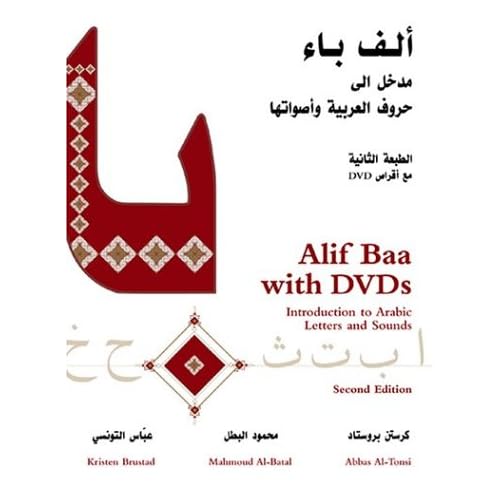
The book - Alif Baa


This title for learning Arabic was recommended by K as being the one for 'people like me' meaning in the main, Americans going into an Egyptian context (even though I am an Englishman in a Syrian one). One recent conversation suggested a link between US foreign policy, diplomacy and Alif Baa, in the sense that the words taught are overtly of a political nature. However, a quick glance through the glossary reveals little of this.

What annoyed me about this book was that a lot of the language we practised to learn the Arabic alphabet and authology was never taught meaningfully. I mean this in the sense that the meanings were never given. Also, it was inconsistent from page to page, sometimes meanings were given, sometimes not. This goes against everything I have been taught and believe about language learning. K argued that this non-focus on meaning was because of the cognitive difficulty of learning to read and write (and deal with meaning) is too much. That said , lady Love has picked up a few words and phrases from the book and we can both read and write (kind of).

The book and DVD-rom were generally thorough and complete. The authology DVD where you watch a professor writing so you can copy was useful. However there wasn’t a lot of variety in the drills and listening activities. Having the answer key built in would also have been useful at times, but I am sure this is evidence of a publishers thinking.

With some letters there was a discrepancy (or at least seemed to be) between the explanation for the sound represented by a character and the sample (for example daad). This could also be down to the fact that there is not a parallel English / French sound (and thus our ears couldn't distinguish it), or to recording quality.

Thursday, February 17, 2011

What is a teacher?


It’s a big question. Let me explain how we have worked as a learner > teacher setup for the last 6 weeks with K, our Arabic teacher.

We have the book, we do a units work (3-4hours work in the evening after work, food and Eastenders ) and then visit him on Saturday. He goes through the homework, corrects what we have written, does a bit of drilling to improve our pronunciation and, that’s it. Then we go away and do 4 hours homework the next week. We return to his space and the cycle repeats. We are learning quite alot, but all the real teaching and certainly the learning is done by me, my girlfriend and the book in a social-constructivist space on our sofa when we really don’t feel like it.

I certainly feel that the routine is really helpful. We were useless on our own as ‘independent learners’ (prior to having a teacher) we never opened a book or played with the DVDS, we messed about on youtube, did a few photocopies and that was about it. So the whole setup; having a teacher; a routine; assistance; feedback on mistakes; a space to go and ‘be taught’ all these things have helped.

Our teacher is confident in his ability to do what he does, because he has done so, alongside his main work as a translator, for 2 years. However, his role in actually teaching us is limited. He provides us with a routine, he assists but I would argue he rarely explicitly teaches us. For me a teacher would teach you something, set you on your way and then set some homework for additional practice. I don’t want to do down on this guy but if you are going to call yourself a teacher, teach. Don’t just correct us. Lead us. Make materials for us. Create a game for us to play. Give us a dialogue to do. Write on the board. Focus us on meaning then form. Manage the time. Set lesson aims. Get us to write on each other’s backs. Make us stand up when we are tired. Focus on accuracy and fluency. Be a teacher. Or be a homework tutor, perhaps.

I am fairly straight up when it comes to this question but I am not sure if I am being fair. How would you feel if you were in the same position? Would you say anything? Do you think I am moaning about having to do some work? Is 90mins too short to do anything but correct homework? I must say that we are on our way to achieving our goals and he’s been good at focusing us on this. So if we are learning is he teaching? Is the fact we are learning enough?

Tuesday, February 15, 2011

Where were the Swiss Arabic Teachers?


In late autumn, Lady Love phoned around local language schools and did some web searching and we came up with a potential school.

Optimistically I arrived at the address in the centre of town and went upstairs. It was a residential style door and I was welcomed by a short shrewy, lady who ushered me in and gave me tea. She only spoke French and I was struggling, but she was fairly aggressively trying to get money out of me; that was for sure.

Lady was late. I was introduced to our teacher, a very smiley, young Tunisian guy. He was nice enough but he seemed a little inexperienced. His 'teacher voice', tone and mannerism were what were described as “talking to me like I am a child”. This was off putting and his approach was unclear and muddled, I didn’t know what was going on. There were no aims for our class. We weren’t asked in any detail by him about what we needed and why. We did our one lesson, an expensive hour, and never called them back.

It seems mean but neither of us were happy with the set up. I felt a responsibility as a fellow teacher to say something that could help develop this guy but I was cautious of the cost of getting dragged into a situation where I am paying to develop my own teacher, who was not really a teacher (by title and qualifications) but an American Studies student. I guess defining what a teacher is, is a part of this whole equation and I will talk about that later.

It was after this initial disappointment that things got a bit stressful. We came across lessons on you tube for example – learn Arabic with Maha have a look

Although this is great fun; she’s easy on the eye and gives a great insight into cultural aspects of modern Arabic speakers. I wanted a teacher-teacher, a real one, a professional who lived and breathed teaching, someone passionate about their job, reflective in their practice, someone who makes plans; adapts and makes materials for their classes based on their students’ needs and interests. We were getting nowhere.
Although we found intensive Arabic courses, these were in Geneva at unsuitable times. We were stymied.

I even stooped as low as to spam my MA coursemates. This was perhaps a little out of order but I went through the course list and wrote to anyone with what I thought was an 'Arabic' name or who was based in a possibly Arab speaking location, asking them if they knew someone who would teach us online over skype (my MA is in Educational Technology and TESOL). No one replied, and I am not sure if I would have answered to such a random message either.

The search continued, Lady Love’s former landlady’s ex-boyfriend, a Moroccan, recommended that we go to Lausanne’s’ mosque on Friday and ask around. We didn’t fancy that much. Perhaps it was the link between education and religion but it didn’t seem like how we wanted to proceed.

One final web search brought us to our current teacher who was suggested to Lady Love via a friend. He is a nice man, slightly older than me. He’s an Iraqi interpreter and has been in Switzerland for 15 years. We met and he explained his method, pointing to the book aliif baa (A, B in English), “this is my method” he said. I was a little reticent about this, knowing full well that a book is not a method. A book is a book.

I didn’t mention this but did mention that I am lacking in experience as a learner and that I am probably quite a difficult student in many respects =O). We agreed a fee, he kindly agreed to teach us on Saturday afternoons (which is regrettable now the six nations rugby has started) and we agreed on aims. These were that we would be able to read and write Arabic and say a few basic phrases by the time we left for Damascus. This was in early January. We are 2 weeks away from departure now and it looks like we are on track to meet this, surprisingly.
So we found a teacher, 6 weeks ago.

So just to recap it seems that choosing a teacher was heavily effected by contextual factors, time, location, the network available, the lack of schools for this purpose, the limits of our research. We both wanted someone live and alive, not to have asynchronous communication. It was also important that French English and Arabic were spoken by our teacher.

Sunday, February 13, 2011

On motivation and Arabic as a lingua franca


(image from hamza online.com text says alif, baa, taa aka a,b,c)

So, when faced with an upheaval to a new country it makes sense to prepare as best you can. Usually this involves vaccinations and then learning a bit of the local lingo, right? Well, this’ll be the first time that I have made such an effort to engage with a language before arriving in a new country. Historically my approach has been to flick through the guide book’s ‘useful phrases’ on the plane or ask someone to teach me on the plane how to say “hello”, “how are you?” “How much is it?” “thanks” etc...This ‘needs must’ approach has served me well, on a practical level thus far, though of course it has limited the kinds of interaction I have. My reliance on minimal language, strong socio-cultural competence, and interpersonal communication skills has done me alright so far. This time, however, it’s quite the opposite approach. I am starting at the bottom and working up, and learning the alphabet sound by sound, letter by letter. I haven’t learnt much in the way of phrases yet and funnily enough it’s hard work!

The reason for all the fuss is probably linked to my motivation. I view Arabic as one of the great global languages, up there with English, Spanish, French and Chinese, in the sense that it can really be used worldwide. No offence to Thai and Bulgarian speakers, but Arabic is just a bit more useful to my future. Perhaps more importantly, I have a lot of emotive, personal reasons for wanting to learn it. Part of this stems from my anti-war persuasion and my country’s foreign polic, partly it is a response to the misrepresentations of and discrimination against Muslims in my country of birth and worldwide. I shan’t go into it in too much detail as this blog is about learning, but needless to say I feel positively towards the Levant and most ‘native speakers’ of the Arabic language who I have met. This would be described as integrative motivation by some. It helps having this or any kind of motivation.

Although it was talked about for months, it wasn’t until that the search began for ways to learn Arabic. I contacted my friend Jessie who had returned from a trip around the Muslim world and his advice was to learn MSA Modern Standard Arabic, okay, a start, but the vast number of ‘Arabics’ that exists is instantly problematic. Which to learn? Which is best? Well like English, none is better, each is just more widely used in different parts of the world and speaking another variety of English will lead to you standing out where the other is dominant. I am not sure if the difference between say Algerian Arabic and Emirati Arabic is more or less pronounced that say the difference between Scottish and Indian English, I guess time and experience (and maybe you) will tell. Syrian Arabic will be our target, preferably with a strong London accent.

Jessie also mentioned that Syrians were amazingly friendly and that Levantine Arabic was widely used and understood so we would be well placed learning how to speak the Levantian version. Ah, the royal ‘we’, yes, ‘we’ are on a mission to conquer the language, me and my girlfriend. Her name is lady Love, she has the job that is taking us there and thus represents the main reason why we need to learn Arabic. And, no, I’m not complaining :O).

We borrowed books from family and friends and these teach yourself Arabic DVDs & CD-ROMS, Rosetta Jones (sic), and Talk Now did much more than gather dust for the autumn months in and amongst the MA books.