Monday, March 12, 2012
A world of words, roles, and differences: Classroom Language
After Christmas I was back at uni again, doing another Classroom Language course. This training provided an opportunity for some undergraduate English literature and language students to do some of our training. They enjoyed it and some of them will go onto build from this in their professional lives; which is ultimately the aim of doing these sessions. Yet, ‘behind the scenes’, in the wings, there were a few tensions and conflict (the good kind you can learn from).
The classroom language course is quite a challenge for trainers and trainees alike. The language and pedagogical content mean that is a tasty sandwich for all to get their teeth into. I co-trained on this most recent course with a more qualified and more experienced Palestinian ELT trainer at a University, Palestine. The University is a long-standing partner and the trainer had observed some of the previous course I had led. For the bosses it seems a logical way to make this kind of course more sustainable, and at the same time keep the novelty (am I a novelty, or an experienced ELT professional?) of having a member of staff from outside of the faculty involved in the training.
The trainer and I scheduled 2 pre-meetings, but feeling confident that our professional culture would bridge our other differences, and time poor, settled for just one meeting. In this meeting we framed the upcoming course as a learning experience for both of us. In retrospect, there were a number of basic things absent from this conversation.
Although, we had had lunch on the earlier course, we didn’t know each other, we didn’t know too much about each other’s classroom experiences as teachers or trainers, our educational backgrounds in any real detail, we didn’t understand each others’ perceptions about teaching and learning: we didn’t share expectations about what this course would be like. This left a lot unspoken and meant our professional culture would bridge a 30 year age difference, among others.
My co-trainer and I hadn’t had enough time to build our professional discourse. What I mean by this is that terms like, for example, the communicative approach to teaching (or training), which we both used, were practiced in different ways. So, weirdly we spoke the same language, but the meanings of the words were different. These false friends then became more problematic as we were attempting to co-train, bringing life to these terms.
It’s important that I say that I am no chauvinist, or TEFL fascist, I am not saying that my way of understanding, or doing say, participant centred training, is the ‘right way’. In fact, I believe that there are many ways of skinning a cat when TEFL, and training, but I do try to, practice what I preach. These approaches to teaching suit me, and mesh well with my background and educational experiences (both as a teacher and student).
Feedback was another term that proved an issue. For me feedback is feedback, explicitly different from error correction, or appraisal. When I asked for feedback, I received (polite) glowing praise, great I thought… My personal feeling about this kind of feedback is that it has little value though, it’s nice to hear, (how does it help me to grow)? My feedback for him, reflected my respect for him as a professional and was questioning and critical of his practice as I am engaged with my own teaching in just this way.
I explained that my exploratory questions were, I thought, in the spirit of our learning, of (our) professional growth. Yet, it became clear, I was off target, had overstepped a boundary, or said something unexpected to a teacher and trainer who had been working for decades (possibly without much observation or appraisal). We smoothed things over before leaving, but we were both a bit off key.
The following day I felt I should apologise for my unsupportive comments, I framed this as a realisation that I needed to be more focused and forward looking in my feedback (something that I strongly adhere to in my teaching) and I made a document to focus the observing trainer. Despite this, at the end of the second day, the time short feedback session was a bit jaded (to be expected I guess).
My co-trainer was interested in the success, or failure of his performance. I was, honestly, offended by the proposition that my role was to judge him. Support him, okay, explore our practice together, fine, but judging him seemed unprofessional to me. This clash in expectations again was based on a contrasting understanding for our motivation for being there. Perhaps he felt I was there to judge him, to report on him (which I am doing now, but writing this blog wasn’t my intention then).
The key thing that I think I learnt from all this, was that giving time before training creates opportunities for relationships to seed. The professor and I have grown closer through this experience, and certainly know each other better, but having more time really would have helped. After sessions time is also an important factor allowing for trainers to de-pressurise before doing peer-feedback.
By smoothing out our expectations, and clarifying our roles, this could have been a smoother experience for us both. At the same time it is a case my co-trainer and I have eventually, been able to learn from this experience. It serves as an example of how you can learn through experiences and how a shared professional culture helped us bridge bigger differences, yet within this community of English Language Teachers (and Trainers) there is also a broad understanding of teaching and learning.

Sunday, February 26, 2012
Rugby in Palestine
Rugby in Palestine
It is of little surprise and considerable annoyance that I cant get a game of rugby in Palestine when this sort of thing happens http://ramallahramblings.blogspot.com/2012/02/now-its-personal.html#more
and the Israeli club playing from Jerusalem move to a hill top the wrong -side of town for me.....getting un-fitter by the day
It is of little surprise and considerable annoyance that I cant get a game of rugby in Palestine when this sort of thing happens http://ramallahramblings.blogspot.com/2012/02/now-its-personal.html#more
and the Israeli club playing from Jerusalem move to a hill top the wrong -side of town for me.....getting un-fitter by the day
Monday, February 13, 2012
guess the grade for my narrative inquiry paper - bids pls
I try to discourage my students from doing it, but I too, am concerned about my performance in my last MA module, Developing Researcher Competence. There are a number of reasons for this, but mainly that this was a new approach to doing things. I moved from an etic, to an emic approach: previously my research had been about me in my class, suddenly it was about other people in strange lands (well not that strange, but you get the picture, I hope)
That said, I am eager to read my feedback and see my grade tomorrow. I am interested because it's, of course, a great chance to learn. I have found plenty of reward in reading, and listening to (yes, some tutors gave audio feedback) my tutors comments. All of the negative stuff I try to reframe as formative in some way. Writing for journals and conference papers is one way to do this. Up next is my dissertation, so there's plenty of good reason to get really stuck into the feedback given.
The piece I wrote for the DRC was very reflective. It was, I suspect too reflective in it's overall orientation (1/3rd was supposed to be reflections). I also have a number of other predictions. I predict that:
1. My choice of topic was too broad, my assignment was about mapping the CPD context for Palestinian English teachers, but this was too general a starting point.
2. Lack of interrogation of my reasons for responding in the ways I did. The reasons I gave seemed very 'basic', e.g. not enough time.
3. I didn't link between the three sections well, in fact i didn't link between the three parts of the paper at all. I think this would have helped me get more in, and avoided repetition...
4. repetition, see above
5.I forgot to include an avenue of thought that may have helped me in my analysis, this was to employ a quantitative tool like ATLAS, or another concordance tool.
6. My analysis lacked focus, I said stuff, which may be interesting, but there wasn't an approach governing my analysis. For example, I could have looked at the symbolic nature of language, or interpreted the instrumental function of aspects of the story...either way an approach rather than all approaches may have worked better for me..
7. I think the process of story-telling can be a beneficial, developmental (co-operative development-esque) and therapeutic experience for the person doing the telling, yet i didn't say this in my rationale for choosing this approach to data generation...It is also beneficial to developing a sense of our professional community and yet I failed to mention this too.
8. Finally, I think I was really overly political in my writing.
My friends Joe, Emma, and Adam were really helpful in their editing (thanks) and their comments have informed some of these comments above. Anyway, what's done is done. For sure I need to plan much better for my dissertation, both structurally and my time in order to have success. One of the major problems with this piece was that I was writing, planning, analysing data, organising very much at the same time (as i was behind schedule). This is best avoided if I want to do myself justice in the dissertation.
I will be getting the results on valentines day at 9am GMT, so post your predictions if you like.
Love you bye ;)
That said, I am eager to read my feedback and see my grade tomorrow. I am interested because it's, of course, a great chance to learn. I have found plenty of reward in reading, and listening to (yes, some tutors gave audio feedback) my tutors comments. All of the negative stuff I try to reframe as formative in some way. Writing for journals and conference papers is one way to do this. Up next is my dissertation, so there's plenty of good reason to get really stuck into the feedback given.
The piece I wrote for the DRC was very reflective. It was, I suspect too reflective in it's overall orientation (1/3rd was supposed to be reflections). I also have a number of other predictions. I predict that:
1. My choice of topic was too broad, my assignment was about mapping the CPD context for Palestinian English teachers, but this was too general a starting point.
2. Lack of interrogation of my reasons for responding in the ways I did. The reasons I gave seemed very 'basic', e.g. not enough time.
3. I didn't link between the three sections well, in fact i didn't link between the three parts of the paper at all. I think this would have helped me get more in, and avoided repetition...
4. repetition, see above
5.I forgot to include an avenue of thought that may have helped me in my analysis, this was to employ a quantitative tool like ATLAS, or another concordance tool.
6. My analysis lacked focus, I said stuff, which may be interesting, but there wasn't an approach governing my analysis. For example, I could have looked at the symbolic nature of language, or interpreted the instrumental function of aspects of the story...either way an approach rather than all approaches may have worked better for me..
7. I think the process of story-telling can be a beneficial, developmental (co-operative development-esque) and therapeutic experience for the person doing the telling, yet i didn't say this in my rationale for choosing this approach to data generation...It is also beneficial to developing a sense of our professional community and yet I failed to mention this too.
8. Finally, I think I was really overly political in my writing.
My friends Joe, Emma, and Adam were really helpful in their editing (thanks) and their comments have informed some of these comments above. Anyway, what's done is done. For sure I need to plan much better for my dissertation, both structurally and my time in order to have success. One of the major problems with this piece was that I was writing, planning, analysing data, organising very much at the same time (as i was behind schedule). This is best avoided if I want to do myself justice in the dissertation.
I will be getting the results on valentines day at 9am GMT, so post your predictions if you like.
Love you bye ;)
Friday, February 3, 2012
Arna's children
I stumbled across this on the Ramallah Rugby Club's facebook page - al Am'ari exiles. It's a feature length documentary Arna's children. I am pretty amazed, and disturbed, by the homevideo footage of these boys growing up in Jenin, a town I led a workshop at two weeks ago. It was the only place I heard the sound of Israeli artillery / bombs going off, down the valley (training exercises I am told). The teachers were completely unphased and called it normal.
In the video below the tale begins by focusing on the Arna, a Jewish, cancer victim, zionist fighter, communist theatre / community leader mother, who marries a Palestinian. In this gradually unfurling story we see how she tries to channel refugee children's suffering through theatre and art. Many of the children in the film are innocent 8-10year olds who go on to die fighting the Israeli occupation, or as suicide bombers as part of the al-Aqsa Intifada (see 21.30-22.30mins).
What initially just struck me from an education perspective was (at around 16mins) the boys in their psycho-drama session act out a scene from their school English class. In this scene 'the teacher' beats the kids for not standing when he enters the classroom. The kids lack of discipline continues as they get struck again for not knowing the alphabet... Have a watch and see what you think...
It made me wonder about the role of discipline in schools, and particularly in the language classroom. A lot of the teachers who I work with are concerned about this aspect, particularly pre-service teachers. This week we were focusing on the benefits of positive reinforcement and praise, at Hebron University,among other things, but I wonder to what extent this has been individuals experiences. What upset me (from a 'teaching and learning'perspective)in the above clip is that the teacher didn't teach anything, just started off by testing and then punished the kids for not knowing. Okay, these kids aren't pedagosists, but they understood their was an issue with their treatment. It's also noteworthy that it was English class, but the only English spoken is: "good morning".
The complexities of this film are massive, you have a female Jewish matriarch and her Jewish, Israeli sons working with young Palestinian boys. The boys find an outlet through the freedom theatre project, but were initially very suspicious of Arna and her family. I wonder to what extent this is the case for teachers I work with: how trusting are they of me? The relationships I have with most of the teachers I work with is usually too brief, and there's not alot of time for 'getting to know each other' building trust, or socialising. I think this social element, rapport, all takes time.
It's a tragedy, in which everyone dies. Jules, the narrator in much of the movie and theatre director was also killed last year Despite the tragic deaths of many involved the symbolic theatre lives on.
In the video below the tale begins by focusing on the Arna, a Jewish, cancer victim, zionist fighter, communist theatre / community leader mother, who marries a Palestinian. In this gradually unfurling story we see how she tries to channel refugee children's suffering through theatre and art. Many of the children in the film are innocent 8-10year olds who go on to die fighting the Israeli occupation, or as suicide bombers as part of the al-Aqsa Intifada (see 21.30-22.30mins).
What initially just struck me from an education perspective was (at around 16mins) the boys in their psycho-drama session act out a scene from their school English class. In this scene 'the teacher' beats the kids for not standing when he enters the classroom. The kids lack of discipline continues as they get struck again for not knowing the alphabet... Have a watch and see what you think...
It made me wonder about the role of discipline in schools, and particularly in the language classroom. A lot of the teachers who I work with are concerned about this aspect, particularly pre-service teachers. This week we were focusing on the benefits of positive reinforcement and praise, at Hebron University,among other things, but I wonder to what extent this has been individuals experiences. What upset me (from a 'teaching and learning'perspective)in the above clip is that the teacher didn't teach anything, just started off by testing and then punished the kids for not knowing. Okay, these kids aren't pedagosists, but they understood their was an issue with their treatment. It's also noteworthy that it was English class, but the only English spoken is: "good morning".
The complexities of this film are massive, you have a female Jewish matriarch and her Jewish, Israeli sons working with young Palestinian boys. The boys find an outlet through the freedom theatre project, but were initially very suspicious of Arna and her family. I wonder to what extent this is the case for teachers I work with: how trusting are they of me? The relationships I have with most of the teachers I work with is usually too brief, and there's not alot of time for 'getting to know each other' building trust, or socialising. I think this social element, rapport, all takes time.
It's a tragedy, in which everyone dies. Jules, the narrator in much of the movie and theatre director was also killed last year Despite the tragic deaths of many involved the symbolic theatre lives on.
Tuesday, January 17, 2012
Ramallah in my own pictures
 Roof of the music NGO, can't remember the name, but amazing architecture.
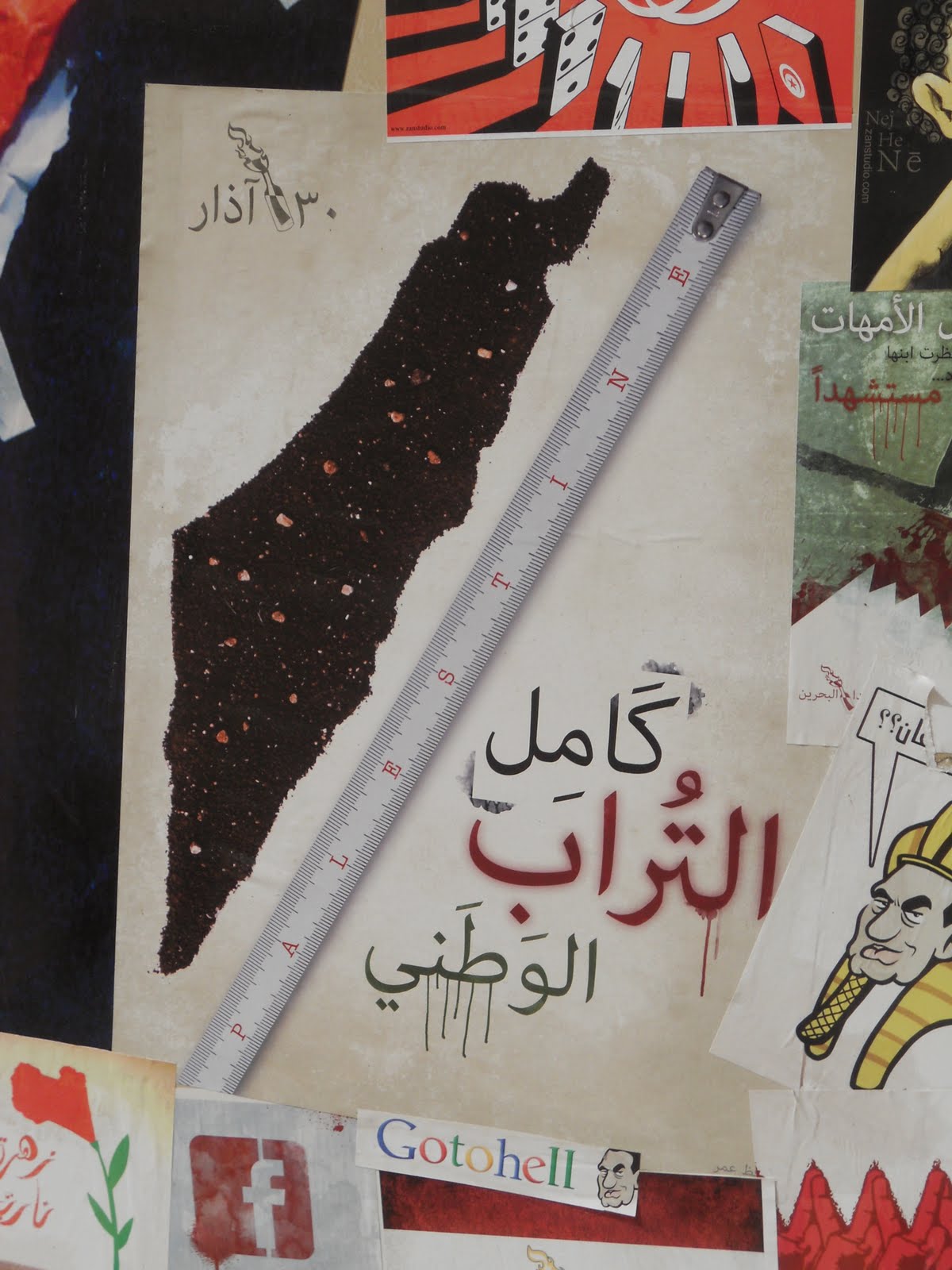 Kamil Altodaan AloTnee...no idea what that means....but can read it, i think...dripping blood..how much blood???
 music school sign
 In the autumn there was a kind of arab spring megalith, full of posters and images of, about and from the region. I like the domino effect in this one... perhaps they will all fall....
 i particularly like Mubarak's nose in this one...
I can't read what's written on Assad's face here...

This is a nice looking building in the old part of town....
Ramallah, my daily place of pilgrimage...my dear sister had to google 'what' it was...For those who don't know it's the defacto capital of Palestinian Occupied Territory. Most of the governments, ministries and foreign organizations are here. I rather like it...:)

Subscribe to:
Posts (Atom)